 |
ArmHis Japanese swords and weapons |
 |
Japanese swords are often masterpieces of swordsmithing, and sword blades with known swordsmith
dating back to 11th.century exists in almost mint condition. Sword blades are guarded as family heirlooms,
and may also have seen combat action through several centuries. The Shirazaya (The mountings)
may have been replaced several times during the centuries.
The study of japanese swords and other japanese traditional weapons is complicated and a science,
described in countless books and thesis. These pages does only present this field on a very superficious level,
hopefully useful as a starting point with rudimentary introduction to collecting and study in this field.
.... scroll down for shortlist of museums exhibiting Japanese arms ......
Short dictionary on Japanese swords (very far from exhaustive!)
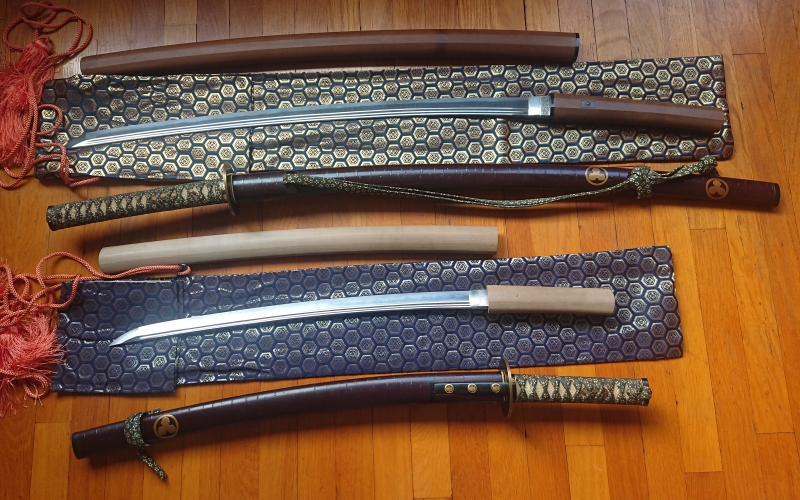
Daisho pair of swords. The Katana is dated to about 1360 and the Wakisashi ca. 1550. The Koshirae early 1800 with gold Noms.
Katana – long sword worn in belt to be drawn sharp edge up for lightning fast draw and cut in same sweep.
Wakisashi – short sword, worn as a Katana, or in pair with a Katana. For close quarter combat.
Tanto – dagger, knife - often carried together with the Katana and Wakisashi
Daisho – pair of Katana and Wakisashi swords. Daisho is a pair of swords worn by the Samurai.
Any pair of swords of different sizes are also referred to as Daisho.
Koshirae - A full set of mounts, not including the blade, is known as the Koshirae.
The individual constituents of the Koshirae, which include Kodogu (metal mountings)
Tsuka and Tsukamaki (hilt and hilt wrap) the Habaki and the lacquering and construction of the
Saya (scabbard) are all collaborations between different artist and artisans with their individual specialities,
whilst the Katana Kaji (swordsmith) and Togishi (polisher) work on the blade itself.
Saya - a scabbard. Specifically refers to the scabbard for a sword or knife.
The saya of a koshirae (scabbards for practical use) are normally manufactured from very
lightweight wood, with a coat of lacquer on the exterior. The wood is light enough that
great care must be taken when drawing the sword; incorrect form may result in the blade
of the sword slicing through the saya and injuring one or more fingers.
Shira-Saya - a storage mount of plain, undecorated wood.
The Koshirae would be kept with a wooden blade, known as Tsunagi.
Hamon - literally “edge pattern” is the visible temper line along the cutting edge of a traditionally
made Japanese sword.It marks the boundary between the hard, rapidly quenched edge (yakiba)
and the softer, tougher body of the blade. It is both a functional result of the heat treatment
and a key element in judging a blade’s craftsmanship.
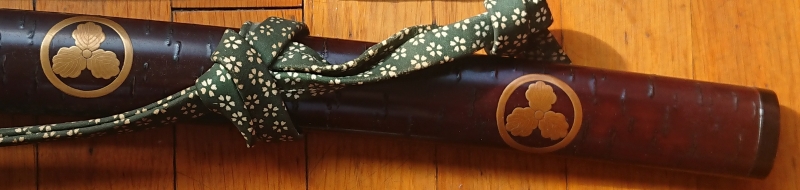
A Mon will not indicate the owner or family of the owner, but normally the warlord the owner served
under or sometime just wanted to show respect.
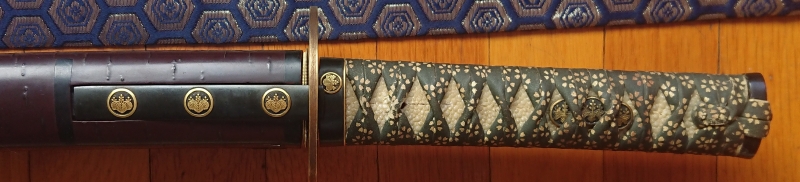
Close-up of the Mon crests on the Daisho pair above: These are two different family crests.
The Mon on the Kogatana above, Kogai is Kiri-Mon (Paulownia leaf). It is one of the best known family crest,
because it is one of three crest used by the emperor family.
The Mon on the Saya below is called Mitsu-Kashiwa (3 oak leaves) which is used by shrines around Japan,
and also the Tosa family of the Kochi prefecture.
Kizu - Flaws in Japanese swords :
Also be sure to sight down the back (mune) of the blade from the nakago (tang) to the kissaki (point) to determine if the blade is bent.
More interesting read on this on: http://www.japaneseswordindex.com/kizu.htm
Bushido, Kendo and Iato -Bushidō, kendō, and iaitō are related to Japanese warrior culture and sword practice,
but they denote three quite different things: an ethical ideal, a martial art, and a practice weapon.
How to Recognise a Good Sword by Clive Sinclaire
A full set of mounts, not including the blade, is known as the Koshirae. The individual constituents of the Koshirae,
which include Kodogu (metal mountings), Tsuka and Tsukamaki (hilt and hilt wrap)
the Habaki and the lacquering and construction of the Saya (scabbard)
are all collaborations between different artist and artisans with their individual specialities,
whilst the Katana Kaji (swordsmith) and Togishi (polisher) work on the blade itself.
http://www.japaneseswordindex.com/gdsword.htm
Some European museums with important Japanese arms exhibits
Samurai Museum Berlin - Peter Janssen Collection - Auguststraße 68 – DE-10117 Berlin
The Samurai Museum Berlin is Europe’s only museum dedicated exclusively to the culture, history,
and way of life of the samurai – www.samuraimuseum.de/en
More than 30.000 artifacts including swords, knives, armours, delicate enameled and lacquered objects
and rare porcelain art. This museum has one of the most important collections of japanese art and weapons
from the Tokugawa/Edo period, 1603–1867. - www.orientalevenezia.cultura.gov.it
Austria - Steyr Arsenal Museum – Innerberger Stadel am Grünmarkt 26, A-4400 Steyr.
Important collection of 60 Japanese swords, but only ca. 10 may be exposed. The most important is a
Tachi attributed to the famous swordsmith Honjo Masamune late 13th to early 14th century.
Swords of this rarity normally cannot be seen outside Japan !
Paris – Musée de l’Armée, "La salle orientale" on the ground floor in department
«Armes et armures anciennes XIIIe–XVIIe siècle» - www.musee-armee.fr/accueil.html
Paris – Musée Musée national des Arts asiatiques - Guimet/MNAAG, 6 place d'Iéna – F-75016 Paris
(Metro Iena - 16e Arrondissement) - www.guimet.fr
UK and London: Several museums probably have interesting japanese weapons exhibited;
The V&A Museum, Wallace Collection and the Royal Armouries in Tower, Windsor and Leeds.
Comments with info on UK-museums are welcome to flint @ ArmHis.com
New York - MetMuseum - The Met Fifth Avenue in Gallery 378 - www.metmuseum.org
and two sword sets. - www.khm.uio.no/english/collections/samurai/index.html
Please mail comments to flint @ armhis.com
Return to Start: Start